
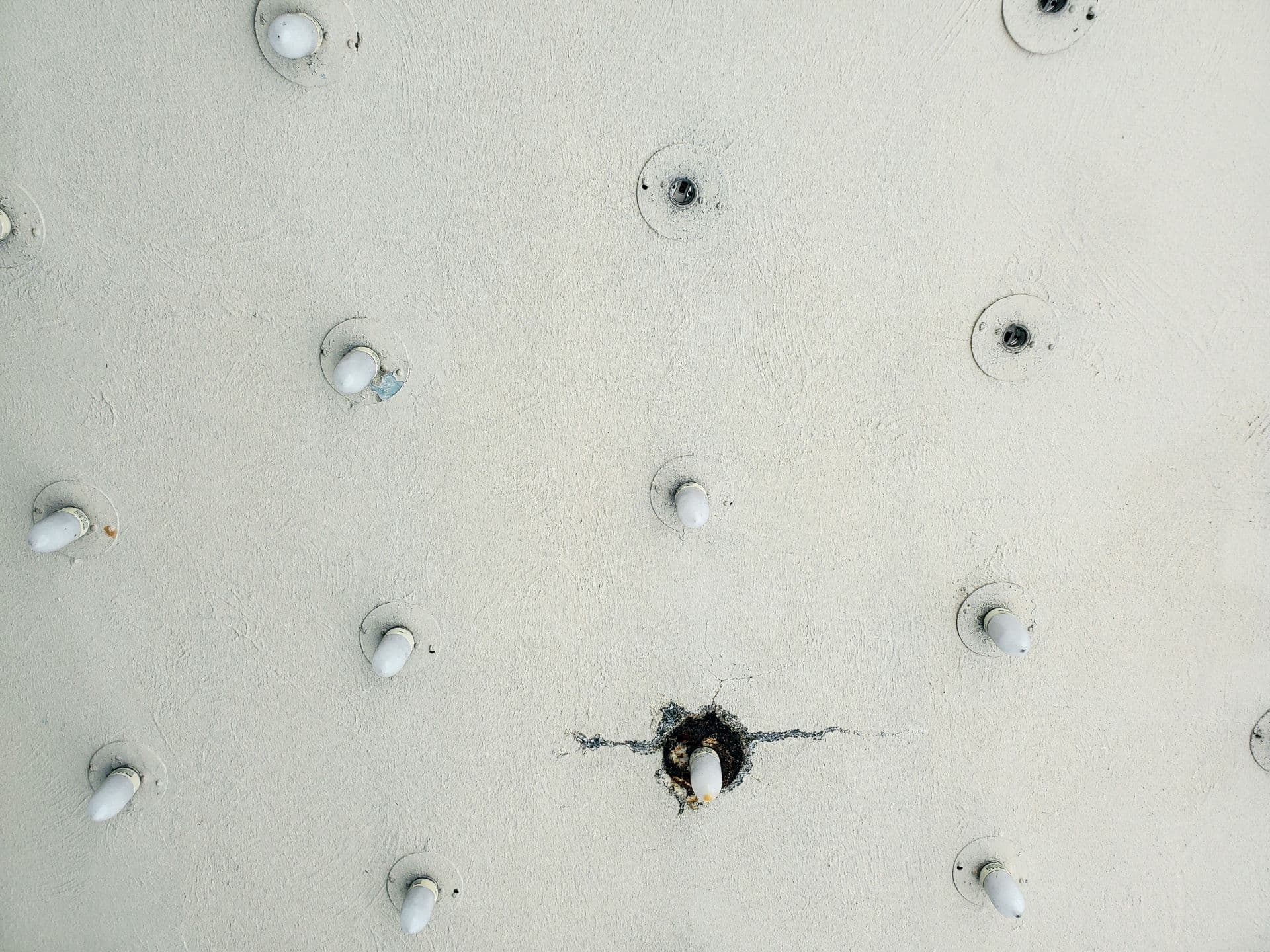
A ceiling stain, crack or change in shape is a reason to investigate, but it does not identify the cause on its own. Water entry, damaged boards, loose fixings, movement and previous alterations can produce overlapping signs. Some repairs concern only finishes; others involve the ceiling support system, services above it or parts of the building that need specialist assessment.
For a Johannesburg homeowner, the first question is whether people should remain in the affected area. The next is what evidence is needed to plan a repair. Repainting before those questions are answered can hide useful information without correcting the underlying defect, while assuming every crack means structural failure can lead to unnecessary alarm.
Put immediate safety ahead of inspection
Keep people away from a ceiling that is newly sagging, bulging, separating, shedding material or making concerning cracking sounds. Do not stand beneath it to obtain a better photograph, collect furniture or test whether the surface feels soft. The visible outline of a stain or bulge is not a reliable boundary for the hazard. Restrict access from a safe position and arrange urgent professional help to assess the affected area.
Do not puncture a bulge, pull down loose material or attempt makeshift support. These actions can expose people to falling debris, concealed services or a wider failure. If collapse appears imminent, leave the affected area and contact emergency services. Our bulging ceiling guide explains immediate precautions in more detail. A website enquiry or a request for a decorative quotation is not the appropriate first response to an immediate danger.
Water at lights, switches or other electrical fittings requires urgent professional attention. Do not touch wet fittings or enter a wet or unsafe area to reach an electrical board. Electrical safety and any isolation needed should be handled with appropriate professional guidance. Keep children, visitors and other occupants informed that the area is unavailable. A ceiling that stops dripping is not thereby confirmed safe, and the room should not be reopened merely because the visible symptom has paused.
Record observations without turning them into diagnoses
From a safe location, note when the problem became apparent and whether it followed rain, plumbing use, building work or an equipment installation. Record any changes already observed rather than approaching the ceiling to provoke or test them. Dated photographs can help the assessor understand progression, but personal safety takes priority over documentation. An earlier photograph of the room may also show whether a joint line, stain or uneven area is genuinely new.
Descriptions should remain literal. Brown discolouration, a line at a board joint, peeling paint and a bowed surface are observations. Roof leak, failed waterproofing and structural movement are possible explanations that require assessment. Crack width or direction alone cannot reliably settle the cause or seriousness. A narrow crack can deserve investigation in context, while a conspicuous line may involve a finish detail rather than the building's main structure.
Include related observations from safely accessible rooms, such as damp near an upstairs bathroom or a change after a fixture is used. Do not assume the room directly above contains the source: water can travel through or along construction before becoming visible. Equally, a familiar historic stain may conceal a new event. A useful record separates what happened before from what is happening now, allowing the assessment to test explanations against a clearer timeline.
Identify the ceiling assembly before specifying repairs
The painted surface does not reveal the complete ceiling system. A home may have plasterboard fixed to timber or metal supports, a suspended grid arrangement, a decorative metal ceiling, or a finish applied beneath a concrete slab. These constructions have different support and repair requirements. Ask the assessor to identify the assembly and explain which parts are affected rather than quoting a generic ceiling patch that assumes every surface is built the same way.
A lining below a roof should not be confused with the structural roof frame, and a surface finish below a slab is not the slab itself. Damage can involve one layer or more than one system. Where there are signs raising concern about structural elements, an appropriately qualified professional should assess them. A decorator or general repair contractor should not be asked to certify structural safety solely because they can replace the visible ceiling finish.
Older or undocumented materials need care before disturbance. The team should establish whether specialist identification or handling is necessary rather than asking the homeowner to cut a sample or enter the cavity. Even familiar-looking boards can conceal different support arrangements and services. Product selection for reinstatement should follow the identified assembly and intended use, including any applicable performance requirements, rather than simply matching the visible thickness or choosing a board described as stronger.
Trace moisture instead of following the stain alone
Rain-related staining may direct attention towards roofing, flashings, external junctions or drainage, but it does not establish the entry point. Water may move across an internal surface or follow another component before it reaches the ceiling. A competent inspection should consider the likely path and relevant surrounding details. Repeatedly coating the roof area directly above a stain without confirming the mechanism can leave the actual defect elsewhere unresolved.
Plumbing is another possible source, particularly where bathrooms, water heaters or other services are located above the affected space. The investigation may need to distinguish supply leakage from drainage or wet-area problems. Condensation is a further possibility in some circumstances. None can be confirmed from stain colour alone. Describe when moisture appears and allow the relevant professionals to decide which observations, access and tests are appropriate for the building.
Where the assessment identifies an external moisture defect, coordinate waterproofing work with the ceiling repair rather than treating them as unrelated purchases. Where plumbing or ventilation is involved, the corresponding work belongs in the same recovery plan. The scope should explain what has been confirmed, what remains uncertain and how the proposed source repair will be checked. A new ceiling is not evidence that the source of the previous damage has been removed.
Consider supports, fixings and later alterations
A ceiling's condition depends on its supports and connections as well as its visible boards or tiles. Damage to one component can affect how adjoining parts behave. The assessor may need to examine fixings, framing, hangers or connections using a safe access method. The owner should not enter a suspect roof space to investigate. Walking on ceiling material or placing weight on unassessed supports can create further danger even when the surface below appears intact.
Tell the assessor about changes above or through the ceiling. New light fittings, fans, access hatches, services or insulation may be relevant to the review, without being assumed to be the cause. Equipment needs an appropriate support arrangement for its actual installation. Do not treat the ceiling lining as a storage platform or presume that a previously installed fixture proves the surrounding construction can support additional items of a similar appearance.
Evidence of damaged timber, corrosion, moisture effects or pest activity should be assessed in context. The presence of one sign does not establish the extent or cause of weakness throughout the roof space. Where specialist structural, electrical or pest expertise is needed, include it in the investigation. Closing the ceiling after addressing only the most visible issue can make unresolved conditions harder to inspect and may lead to repeated disturbance of the new work.
Ask for a coordinated assessment of cause and extent
A useful assessment should distinguish immediate safety measures, investigation and permanent repair. These are different tasks and may involve different providers. Ask who decides whether the room can be used, who assesses the source, and who designs or specifies any necessary structural work. Clear responsibility is particularly important where a roofer, plumber, electrician and ceiling installer are all involved, because each may otherwise expect another person to confirm that the area is ready.
Discuss access before inspection starts. The contractor should explain how people and belongings will be protected and how openings or temporary arrangements will be managed. Where concealed conditions cannot be confirmed initially, the quotation should identify that limitation. An inspection from below may support a preliminary scope, but it should not be presented as proof that every support, hidden service or adjacent board has been checked and found suitable for retention.
Ask for findings in a form you can understand. Which source has been identified? Which parts of the assembly are damaged? What needs further investigation? What must happen before reinstatement? Moisture readings, photographs and other records can support the assessment when interpreted appropriately, but a single measurement is not a complete diagnosis. The value lies in connecting evidence to a reasoned scope and explaining the remaining uncertainty instead of simply listing observations.
Compare local repair with wider replacement
Localised repair can be appropriate where assessment confirms a limited defect and the surrounding assembly is suitable to remain. The decision should consider support, material condition, joint locations and the ability to restore the required finish and performance. A visible stain is not enough to determine how much board must be removed. Nor does a large stain necessarily mean that an entire room requires replacement if the underlying findings support a smaller defined intervention.
Wider replacement may be proposed where deterioration is extensive, supports need substantial correction or repeated patches would leave an unsuitable assembly. Ask the contractor to explain the reasoning and identify what would be retained. Compare alternatives by the work they accomplish, not merely the area of new board. A larger replacement that leaves an unresolved support defect is not a more complete repair simply because more of the ceiling has been renewed.
Finishing expectations should also be explicit. Patching may leave differences in texture, joint visibility or paint appearance unless the agreed work addresses them. Confirm whether the quotation includes adjoining areas, cornices, access panels and the necessary preparation for a consistent finish. These appearance questions come after safety and cause assessment, but they still matter when comparing quotations. An owner should know whether a price covers a sound local repair, a full decorative finish, or both.
Sequence source repairs, reinstatement and decoration
The repair programme should show the relationship between source correction and ceiling reinstatement. Damaged material may need controlled removal before the full extent can be assessed, while other work may need to wait until the source has been addressed. The contractor should manage this sequence and any temporary protection. Do not treat an urgent opening-up operation as completion of the repair, or allow finishing work to cover an area that still needs investigation.
Drying and suitability for closure require assessment rather than a fixed promise based on elapsed days. Conditions, materials and the amount of moisture can differ. The team should explain what must be dry, sound or checked before new boards, insulation or finishes are installed. Electrical components exposed to moisture need the appropriate professional review. A surface that looks dry to an owner is not proof that the concealed assembly and services are ready for reinstatement.
Once the underlying work is complete, interior painting can form part of the final restoration. Suitable preparation and a compatible primer may address residual staining in a sound substrate, but paint does not stop a leak or restore weakened board. Confirm the finishing specification and how repaired areas will blend with retained surfaces. The completed room should reflect the agreed scope rather than relying on a new coat to disguise unresolved damage.
Keep records and clarify insurer or property responsibilities
Preserve safe photographs, dates, assessment notes and relevant invoices. Record the immediate precautions taken and retain information about previous related repairs where available. These documents help a contractor understand the history and may be useful when dealing with an insurer or another responsible party. Do not delay urgent safety measures in order to create a more complete record, and do not enter an unsafe room to recover paperwork or damaged belongings.
Where insurance may be involved, contact the insurer about its process and the evidence or authorisation it requires. Coverage and reimbursement depend on the policy and assessment; neither a contractor's quotation nor the presence of storm damage guarantees payment. Our insurance repair service information can support a scope discussion, but it is not a substitute for the insurer's decision. Keep emergency measures, investigative work and permanent reinstatement distinguishable in the records.
In rented, shared or sectional-title property, notify the appropriate owner, managing agent or body responsible for coordinating the building response. The source may involve another area or a shared service, so access and responsibility need clarification. Do not assume that the room in which damage appears determines who must arrange every part of the repair. Keep communications factual and attach the relevant assessment rather than attributing blame from the visible stain alone.
Make follow-up specific to the identified problem
Consider a hypothetical stain below an upstairs bathroom. The owner notices that it changes after shower use but does not approach the damaged ceiling. Investigation may distinguish a plumbing connection defect from a wet-area assembly problem, or identify another source altogether. The repair scope then follows those findings. The timing observation helps direct the enquiry, but it does not justify replacing the shower sealant and assuming the ceiling is safe without further assessment.
After reinstatement, retain the final scope, relevant photographs and any outstanding monitoring or maintenance advice. Observe accessible areas during normal use and report recurrence or new movement promptly. Do not repeatedly probe the repair to check its strength. Follow-up should relate to the actual source and installed system, including roof, plumbing or other maintenance identified by the assessment. There is no universal inspection interval that suits every ceiling and building condition.
A planned maintenance assessment can help address related defects before they cause further disruption. Ask for clear priorities and distinguish urgent safety issues from routine upkeep and appearance work. The objective is neither to dismiss ceiling marks as cosmetic nor to treat every imperfection as evidence of imminent collapse. It is to keep people safe, establish the cause with appropriate expertise, and complete the repair in a sequence that leaves the building understandable and maintainable.